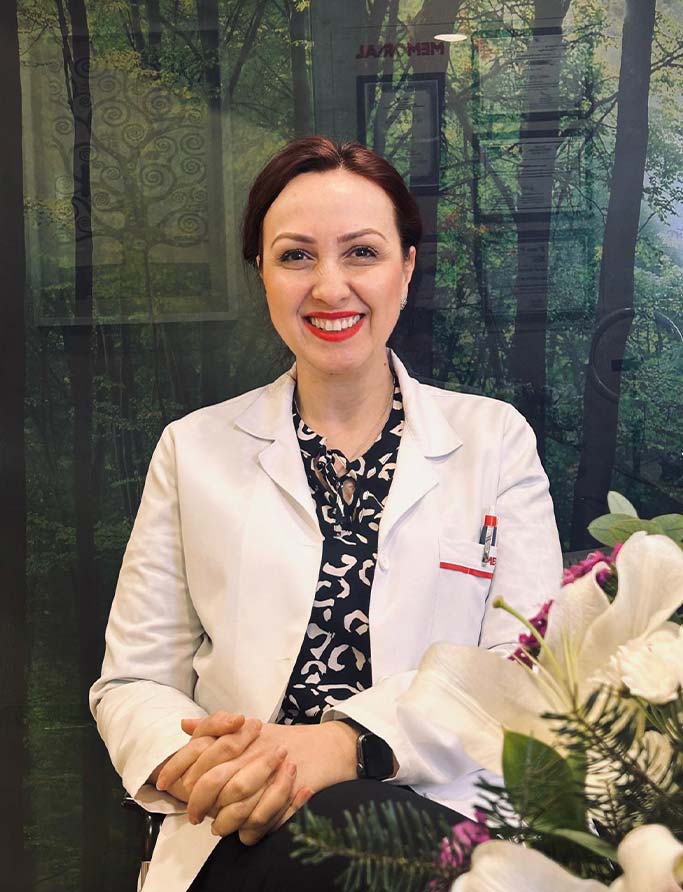
Prof. Dr. Ebru ÇÖĞENDEZ

Professor Doctor

Ebru ÇÖĞENDEZ

IVF Specialist

The health journey is not only a treatment process, but also a process of inner discovery and empowerment. Prof. Dr. Ebru Çöğendez will be with you at every step of this important journey and with you in your most precious moments.

About
Prof. Dr. Ebru Çöğendez

Prof. Dr. Ebru Çöğendez was born in Karadeniz Ereğli in 1971. She graduated from Istanbul University Cerrahpaşa Faculty of Medicine as the top student of her class between 1988 and 1994. Dr. Çöğendez passed the Medical Specialty Examination in the year she graduated. Between 1994 and 1998, she completed her specialization in Obstetrics and Gynecology at Istanbul Zeynep Kamil Women and Children’s Diseases Training and Research Hospital, and between 1996 and 1997, she completed her specialization at St. Mary’s Hospital in London.

In 2001, Prof. Dr. Ebru Çöğendez was appointed as an Assistant Professor to the Obstetrics and Gynecology Clinic at Zeynep Kamil Women and Children’s Diseases Training and Research Hospital. After working for many years as an Assistant Professor, she became an Associate Professor in 2016 and continued her duty with the title of Professor at the Department of Obstetrics and Gynecology at Health Sciences University Hamidiye Faculty of Medicine in 2022. She later served as a faculty member in the Department of Obstetrics and Gynecology at Üsküdar University Faculty of Medicine. Her research primarily focuses on female and male infertility, IVF (In Vitro Fertilization), laparoscopy, and hysteroscopy.

Çöğendez, who values education highly, has made significant contributions to the scientific field through articles published in international and national peer-reviewed journals, presentations at scientific meetings, and chapters written for books. Additionally, she is a member of important associations such as the Turkish Society of In Vitro Fertilization and Infertility (TÜBİD), Society of Reproductive Medicine and Surgery, and Turkish Society of Gynecology and Obstetrics.

She currently serves as an IVF Specialist in the field of Obstetrics and Gynecology at Memorial Ataşehir Hospital in Istanbul and continues her profession successfully.

TREATMENT METHODS

Make your appointment with Prof. Dr. Ebru ÇÖĞENDEZ!

By filling out the form, you can make an appointment with Gynecology and Obstetrics Specialist Prof. Dr. Ebru Çöğendez.

Press Room

Photo Gallery

Frequently Asked Questions

IVF treatment is a method used to help couples with infertility to have a child. This treatment is carried out by fertilizing the eggs taken from the woman’s ovaries in a laboratory environment and transferring the embryos to the uterus.


IVF treatment is recommended for couples with various reproductive health problems. These can include blocked tubes, male factor infertility, endometriosis, polycystic ovary syndrome and poor sperm quality. The treatment recommendation is based on the couple’s health condition and the doctor’s assessment.


The course of IVF treatment can vary depending on the condition of the couple and the requirements of the treatment. Usually, the treatment process takes about 4 to 6 weeks. During this period, hormonal medication, egg maturation, egg collection, fertilization and embryo transfer are carried out.


The success rate of IVF treatment depends on many factors. These include the couple’s age, health status, compliance with the treatment and clinical factors. In general, the success rate of IVF treatment varies between 30% and 50%. However, since each couple’s situation is different, the success rate should be evaluated individually.


The cost of IVF treatment varies depending on the couple’s course of treatment and the services they use. Factors in the treatment process may include hormonal medications, additional tests, embryo freezing and transfer procedures. There may also be price differences between clinics. It is recommended to consult your doctor for a detailed cost planning.


The insemination procedure is usually associated with mild discomfort, but each individual has a different pain threshold. Usually there is minimal or no pain during the vaccination procedure. Some women may experience mild cramping or a feeling of pressure in the uterus, but this usually passes quickly and tolerably.


Vaccination treatment varies depending on the couple’s situation and the recommendations of the health care provider. In the first phase, 3-6 vaccination attempts are recommended for most couples. However, every couple’s situation is different and some couples may need more attempts at vaccination. Your health care provider will determine the most appropriate treatment plan for you.


The chance of conception after embryo freezing is possible by thawing and transferring frozen embryos. Although success rates vary from person to person, the use of frozen embryos can increase the chances of conception.


Embryo freezing is preferred for storing excess embryos in IVF treatment, for older expectant mothers or for couples who want to interrupt treatment due to health problems. Embryos can also be frozen in cases where genetic tests are required.


There may be many reasons for recurrent failures during IVF treatment. Factors such as genetic factors, embryo quality, immunologic problems and endometrial receptivity problems can contribute to failures.


Genetic tests help to detect genetic abnormalities in embryos. This makes it possible to select healthy embryos and increase success rates.

My Blog Posts

Lorem ipsum dolor sit amet, consectetur adipiscing elit. Ut elit tellus, luctus nec ullamcorper mattis, pulvinar dapibus leo.